
NJS Blog - Reflections

Devotion to the Blessed Sacrament in April: Reflections through the "Communion of the Apostles" Iconography
In the Communion of the Apostles, we visually encounter the catechesis presented in the Catechism on the Paschal Banquet, “The altar, around which the Church is gathered in the celebration of the Eucharist, represents the two aspects of the same mystery: the altar of sacrifice and the table of the Lord. (CCC 1383). Therefore in this image, standing in priestly vestments, we encounter Christ as both the Priest offering the sacrifice and as the unblemished Lamb being sacrificed.
by sacred artist Ruth Stricklin
In the month of April, the faithful turn their gaze toward the Blessed Sacrament—a divine mystery that transcends the bounds of human comprehension. Just as the sun's golden rays illuminate the earth, so too does the presence of Christ in the Eucharist illuminate the soul, infusing it with divine grace and love. St. John Chrysostom, with his eloquent words, called the Eucharist the "medicine of immortality"—a sacred remedy for the afflictions of the soul. In this Holy Sacrament, we encounter the fullness of God’s love, a love so profound that it becomes food, by which he nourishes his own Body, the Church.

Explore the art as Ruth shares the rich details of this work in a vlog!
As we embrace this devotion during April, the "Communion of the Apostles"—an artwork created in 2020—serves as a powerful visual catechesis. It invites us into a deeper contemplation of the sacred mystery of the Blessed Sacrament, urging us to approach the altar with the same reverence and awe that the apostles did, for they were the first to receive this precious gift. Rooted in Byzantine iconography, this image is rich in theological symbolism, guiding us into a greater understanding of Christ's real presence in the Eucharist.
The celebration of the Eucharist in the Mass is the sacred ‘trysting place’, where the divine breaks into the ordinary and sanctifies it. The "Communion of the Apostles" at once calls to mind the Last Supper, but presents it in its liturgical fullness. Jesus is the true Eternal High Priest, standing in priestly vestments, not at the table of the Last Supper, but before an altar, adorned with festive altar cloth. The unleavened bread of Passover is presented in a liturgical ciborium. And the "upper room" is now presented as a church, with the four-pillared baldachin. Christ offers himself to the Father and nourishes the faithful through the sacrament of the Eucharist. It is a reminder that the Eucharist is not merely a symbol but a real and tangible communion with Christ.
The Eucharist is the very source and summit of our Catholic faith—the wellspring of spiritual nourishment and strength, both individually and as the Body of Christ. As depicted in the Communion of the Apostles, the apostles, Saints Peter and Paul, are fed not only in body but in soul, receiving the dual nourishment that lies at the heart of our devotion to the Blessed Sacrament. In receiving the Eucharist, we, too, are sustained in body and soul, fortified by the divine grace that flows from this holy gift.
Consider downloading our free Visio Divina guide for The Communion of the Apostles after exploring the image and its symbolism in greater detail.
Symbols in the "Communion of the Apostles"
The artwork is rich with symbolism that invites further reflection on the Eucharist’s profound meaning.

The Peacocks and the Vine
The peacock is an ancient symbol of eternal life in Christian art, as it was believed its flesh does not decay, representing the indestructible nature of the soul. The vine, as described in John 15:5, signifies Christ as the source of life. Together, these symbols speak to the unity of the Church, rooted in Christ and nourished by the Eucharist.

Altar Tools: These represent the sacred instruments of the liturgy in the Eastern Rite and the sacred work of priests, highlighting the connection between the earthly celebration of the Eucharist and the heavenly Liturgy.
The Angels: Angels in this image signify heaven’s presence and the myriad of heavenly hosts participating in every Liturgy. They remind us that the celebration of the Eucharist is not just an earthly act but also a heavenly one.

Liturgical Fans (Rhipidia): Traditionally waved by deacons during the Liturgy, rhipidia symbolize the six-winged seraphim, celestial beings who are thought to be present during the Mass. Held by the attending angels, these are symbolic of the angels’ role in worship, and represent the beating wings of the seraphim near the throne of God.
The Canopy: Serving as a sign of reverence and protection, the canopy, or baldachin, symbolizes protection over the precious offering on the altar and the covering of God's grace over the faithful. It also emphasizes the place where the bridegroom (Jesus) encounters his bride (the Church) in a covenant of everlasting love, a type of bridal chamber, recalling the sacrament of Matrimony.
Tree: The tree, reminiscent of the tree depicted in the ancient Icon of the Holy Trinity by Rublev, is an image of the Tree of Life, a reference to eternal life in Christ. It also recalls the wood of the Cross, linking the sacrifice of Christ to the Eucharist.

The Saints and Symbols The presence of saints in the icon symbolizes the Church Triumphant in heaven, united with the Church on earth during the Mass. St. Peter, depicted with the Keys of the Kingdom of God, and St. Paul, shown with the sword of the Word, represents the apostolic foundation of the Church and our shared communion in faith. Paul, although not present at the Last Supper, represents the mission to the Gentiles.
Christ as Priest, Altar, and Sacrifice: In the Communion of the Apostles, we visually encounter the catechesis presented in the Catechism on the Paschal Banquet, “The altar, around which the Church is gathered in the celebration of the Eucharist, represents the two aspects of the same mystery: the altar of sacrifice and the table of the Lord. This is all the more so, since the Christian altar is the symbol of Christ himself present in the mystery of the assembly of his faithful, both as the victim offered for our reconciliation and as food from heaven who is giving himself to us.” (CCC 1383) Therefore in this image, standing in priestly vestments, we encounter Christ as both the Priest offering the sacrifice and as the unblemished Lamb being sacrificed.
A Call to Communion

Click the Image of Venerable Fulton Sheen for the second video in the Vlog on The Communion of the Apostles by Ruth Stricklin
Bishop Fulton J. Sheen likened the Eucharist to a divine embrace—where heaven and earth meet, and the soul is drawn into the heart of God. In the Mass, Christ is always present, patiently waiting for us to come into communion with Him. It is in this intimate encounter that we are transformed—our hearts set ablaze with divine love, our spirits lifted toward the heavens.
As we reflect on the "Communion of the Apostles" to inspire our devotion to the Blessed Sacrament, may we be drawn into a deeper communion with the Lord and be transformed by His presence. Like the apostles, may we receive this gift with reverence, allowing it to nourish our souls and strengthen our faith. We are reminded of the words of St. John Chrysostom:
“The Eucharist is a fire that inflames us. Let us return from that table as lions breathing out fire, thus becoming terrifying to the devil.”
The Eucharist empowers us, infuses us with divine strength, and equips us to live out our faith with courage and conviction. If you would like to pray with the image during Adoration in this month devoted to the Blessed Sacrament, we invite you to download our The Communion of the Apostles Visio Divina. We will you in the Eucharist!

Uncovering the rich symbolism in the Holy Family so you can more deeply encounter God.
Discover the rich symbolism and divine proportions that allow the a viewer of the image of The Holy Family to encounter the divine and confront the true nature of the family as an icon of the Holy Trinity.

Sacred art is like a visual poem, using symbolic language to help the viewer discover deeper mysteries. In order to do this, one must spend time with it to allow the meaning to unfold.
In the past year we encountered thousands of people at our booths at both the National Eucharistic Congress in Indianapolis and SEEK in Salt Lake City. Displaying a large-scale canvas giclee print of The Holy Family, our booth drew in people who stopped in their tracks to stare at the image, seemingly attracted by some unseen force. Created using divine proportions and rich traditional symbolism, this artwork captivated viewers, not because of its overt emotional expressiveness or provocative style, but because of the sacramental power of sacred art, which strives to reveal the invisible reality of heaven.
Sacred art as a genre is not meant to merely entertain the viewer or manipulate our emotions to feel more spiritual – it is intended to reveal the invisible reality of heaven, the objective truths of our faith and the mind of God. How we encounter that truth is up to us, whether we receive or reject it. Sacred art is like a visual poem, using symbolic language to help the viewer discover deeper mysteries. And like poetry, which is not meant for quick consumption, one must spend time with it in contemplation to allow the layers of meaning to unfold.
Here, we examine in more depth the main themes and rich symbolism explored in this work.
Sacred art is intended to reveal the invisible reality of heaven, the objective truths of our faith and the mind of God.
FIGURES IN THE HOLY FAMILY
The Double Trinity
This image depicts a foundational and profound mystery of our faith – the family.
God Himself – Father, Son and Holy Spirit – is Himself, a Family. Earthly families – husband, wife, and any children that God gives them – is a living image or ‘icon’ of the Blessed Trinity. Therefore, this image includes a portrait of both the heavenly Family as well as a portrait of the human family – represented by the Holy Family of Joseph, Mary and Jesus. Combining the Holy Trinity and the Holy Family in a single image is known as the “double trinity” in the sacred art of the Spanish Colonial period of Latin America.
Joseph, Mary and Jesus
The Holy Family is shown as strong but warm and approachable, a healing image for a culture where the traditional family has been relentlessly attacked and degraded. Jesus is the center of His earthly family, a stabilizing force that unites its members. He holds onto both Mary and Joseph, and it is only in and through Him that they are united. Mary and Joseph do not physically touch, which further reveals the truth of Mary’s perpetual virginity. St. Joseph holding Jesus with his large, strong carpenter hands presents an image of a strong, fully present and faithful follower of Christ, in close relationship with Him.
Mary’s Garments

This image was commissioned by the Diocese of Phoenix for its 50th Anniversary in 2019. Because Our Lady of Guadalupe is the patroness of the diocese, Mary’s garments reflect the patterns visible on the Divine Image of Our Lady of Guadalupe that appeared on Saint Juan Diego’s Tilma in 1531. The original flower pattern in Mary’s gown contains a whole narrative in the pictorial Aztec language that the Aztec people of the time would have read like a book. Squash blossom flowers reveal stylized human faces, with stems that grow out of a field of deep celestial blue. This tells of the value and dignity of the human person, created from a divine source for a holy purpose, with an eternal soul. In a few short decades after Our Lady of Guadalupe appeared, all human sacrifice in the Aztec temples had ceased because of this powerful, miraculous image.
Joseph’s Garments
On his cloak, Joseph, from the Tribe of Judah, bears the symbol of the Lion, similar in style and derived from the flower of Mary’s tunic. His outer cloak is wrapped protectively around his inner tunic, which shows Mary’s flower, the tender fleur de lis, or lily. In this symbolic language, Joseph is shown as the protector of Mary and the family.


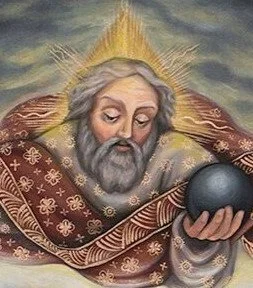
Jesus and the Father’s Garments
On the original gown of Our Lady of Guadalupe, there is a single four-petaled flower over her womb. This was understood to represent divinity, the ‘God Flower’ to the Aztecs - and signified the Christ Child in Mary’s womb. Therefore, in this image of The Holy Family, her gown no longer bears that flower. Rather, it is shown as the pattern on Christ’s garment, and this same flower is mirrored with more embellishment in God the Father’s cloak.
THE LANDSCAPE
The theme of this painting is the familiar story of the Holy Family and their Flight into Egypt. Native desert plants of the Arizona southwest comprise the landscape, with the intent of drawing the people for whom the painting was commissioned from their current environment into the eternal reality. As I worked on this piece, I considered the plight of this family; how incongruous that they are exiled, fleeing for their lives, and yet, they are so serene! How can this be? As one viewer noted, “You don’t know whether the storm clouds are gathering or dissipating, but the Holy Family looks out at us with peaceful perseverance and strength.” Perhaps this image is a reminder that the Holy Family also once physically walked the treacherous road of life, and they are now present to us, as we find ourselves in painful or difficult circumstances. We are all exiles from our original Eden. They also mirror us, showing us that in the storms of this world, we have an eternal destiny. They show us how to walk the path laid out before us in faith, and they accompany us on our way.
THE STRUCTURE
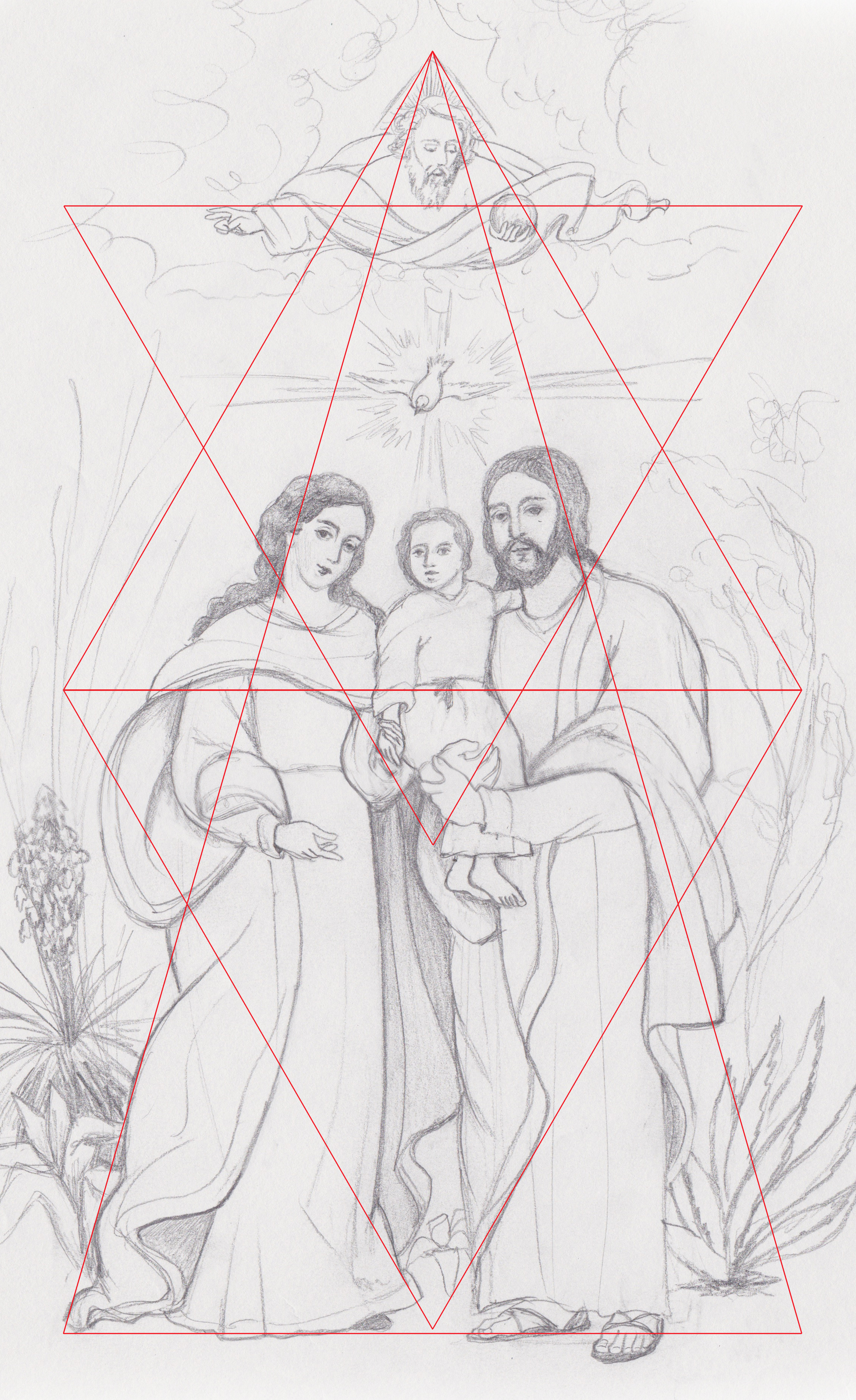
The underlying structure of the image contains within it the divine proportion, a prominently repeating ratio in nature (God’s creation) and also used in and art, science and math from the time of the ancient Egyptians to present day architects. The divine proportions are known to present a perfectly aesthetic composition communicating cohesion and completeness. In this example, the upper half of the composition unites both the heavenly Family and earthly family within the Star of David and also contains the mirrored construct of two isosolese triangles, suggesting the earthly Family is an icon of the heavenly family.
#/media/File:Angelsatmamre-trinity-rublev-1410.jpg)
The underlying composition follows layers of symbolic geometric constructs in multiple directions as noted by the multiple triangle overlay.
The vertical center of the painting is occupied by the three Divine Persons of the Blessed Trinity - God the Father, the Holy Spirit, and Christ. The human, Holy Family occupies the horizontal axis of the painting, with The Christ Child in the center of both families – uniting the Divine and the human within a cruciform framework.
VISIO DIVINA
The layered symbolism shared here can provide a richer foundation to take to prayer with the image in the practice of “Visio Divina” or “Divine Seeing”. One might consider sitting with this image and reflecting on one or more of the following questions:
What does this image communicate to me about the nature of God? Do I sense an invitation from God in some way when viewing this image?
What emotions do I experience when gazing at this image? Where might I imagine myself in the image?
What does this image tell me about the “desert” experiences in my own life? Are my storm clouds gathering or dissipating, and how can the Holy Family speak into this?
In the place we find ourselves, are we holding on to Christ, centering Him in our lives and our own families? (See a reflection of Bishop John Dolan on the Holy Family here.)
Finally - Here we share an article by Bishop Emeritus Thomas Olmsted on the family for additional reflection.